Appearance
Worked example: redis/go-redis
Every number and screenshot on this page comes from one real run against redis/go-redis at commit 216593cc, on a laptop, with gpt-5.4-mini behind all three completion roles. Nothing here is a mock-up.
It is a useful example because it is uncomfortable: 369 Go files, 5,946 functions, no classes at all, nine files behind build constraints, and a README.md in almost every subdirectory. If the pipeline produces something readable here, the claims on Generated wiki mean something.
What went in
| Input | Value |
|---|---|
| Repository | github.com/redis/go-redis, branch master |
| Commit | 216593cc01faa029006266a5f1fc3d5004312ecf |
| Source files indexed | 369 of the 373 .go files in the tree |
| Graph nodes | 7,099 (369 modules, 5,946 functions, 0 classes) |
| Repository documents | 110 → 790 chunks (38 markdown, 29 go.mod, 24 example .go, 12 CI workflows, 7 other) |
| Embedding model | text-embedding-3-small, 1536 dim |
| Completion model | gpt-5.4-mini for all three completion roles |
Two rows in that table are worth unpacking.
classes: 0 is not a failure. Go has no classes, and Cograph does not invent a node kind to fill the column — a struct is a struct, and the count you see is the count that exists.
Repository documents are not just markdown. Only 38 of the 110 are .md. The rest are the files a reader would actually reach for to answer "how do I run this": 29 go.mod files, the 24 .go programs under example/, and 12 CI workflows. See Document RAG for the discovery rules.
And 369 is four short of 373 on purpose. Those four are the files the default build does not compile:
| Excluded file | Constraint |
|---|---|
extra/rediscmd/safe.go | //go:build appengine |
internal/util/safe.go | //go:build appengine |
fuzz/fuzz.go | //go:build gofuzz |
internal/pool/conn_check_dummy.go | //go:build !linux && !darwin && … |
Their counterparts — unsafe.go twice, and conn_check.go — are indexed. No tag was passed, so appengine is absent, !appengine holds, and gofuzz is absent. That is the same set of files go build with no -tags would compile, and getting it wrong is not cosmetic; see the last section.
What came out
Fourteen pages, one level deep under index:
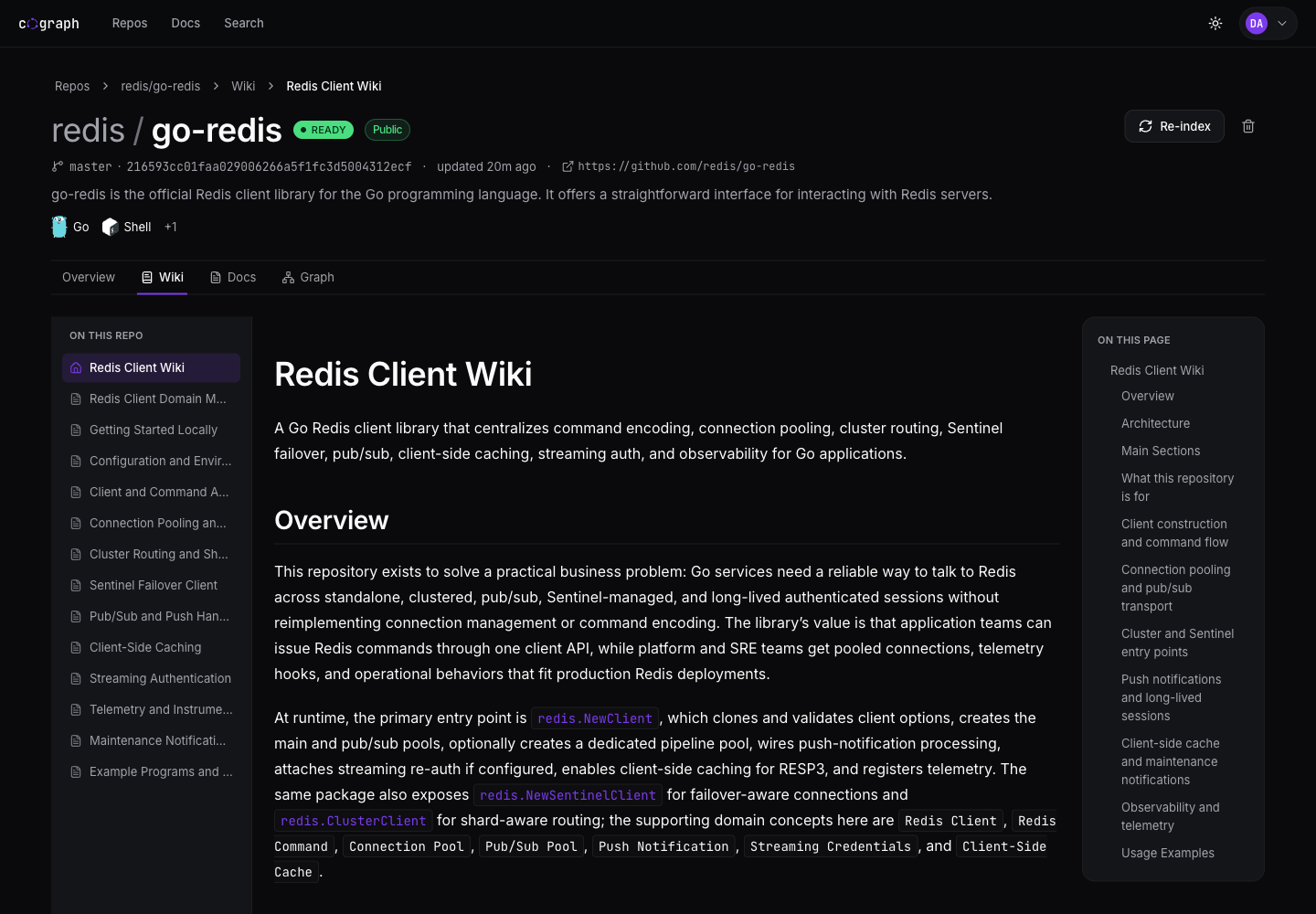
Every screenshot on this page links to its full-resolution capture.
index                          Redis Client Wiki
├── domain-and-business-context Redis Client Domain Model
├── getting-started             Getting Started Locally
├── configuration               Configuration and Environment
├── client-and-commands         Client and Command APIs
├── connection-pooling          Connection Pooling and Protocol I/O
├── cluster-routing             Cluster Routing and Shard Decisions
├── sentinel-failover           Sentinel Failover Client
├── pubsub-and-push             Pub/Sub and Push Handling
├── client-side-caching         Client-Side Caching
├── streaming-auth              Streaming Authentication
├── telemetry-and-instrumentation  Telemetry and Instrumentation
├── maintenance-notifications   Maintenance Notifications
└── example-usage               Example Programs and Concrete Usage
Those titles are worth a second look, because they are the part a template cannot produce. Nothing in the repository is named "maintenance notifications" or "streaming authentication"; the planner named those pages after reading the code, and both correspond to real directories (maintnotifications/, internal/auth/streaming/).
Total body: 190,782 characters across the fourteen pages, carrying 136 citations.
The size distribution is uneven on purpose:
| Page | Body | Citations |
|---|---|---|
example-usage | 22,807 | 13 |
maintenance-notifications | 20,987 | 25 |
streaming-auth | 17,092 | 15 |
connection-pooling | 16,700 | 21 |
domain-and-business-context | 14,813 | 4 |
| … | ||
configuration | 1,484 | 2 |
configuration is short because go-redis is a library: its configuration is a struct you pass to a constructor, and there is no environment contract to document.
It is also, by a wide margin, the page that cost the most to produce. Its recorded quality block reads: 15 agent turns, 16 files read, 27 read_file and 21 read_node_by_qn calls, three write_page attempts, 925,018 tokens — to emit 1,484 characters and two citations. example-usage, fifteen times longer, took five turns and 311,591 tokens.
That is the quality contract working as intended rather than a bug. Effort does not become length: the agent kept looking for groundable configuration surface, did not find much, and shipped what it could cite instead of padding the page to look complete.
What a page actually looks like
cluster-routing, unedited:
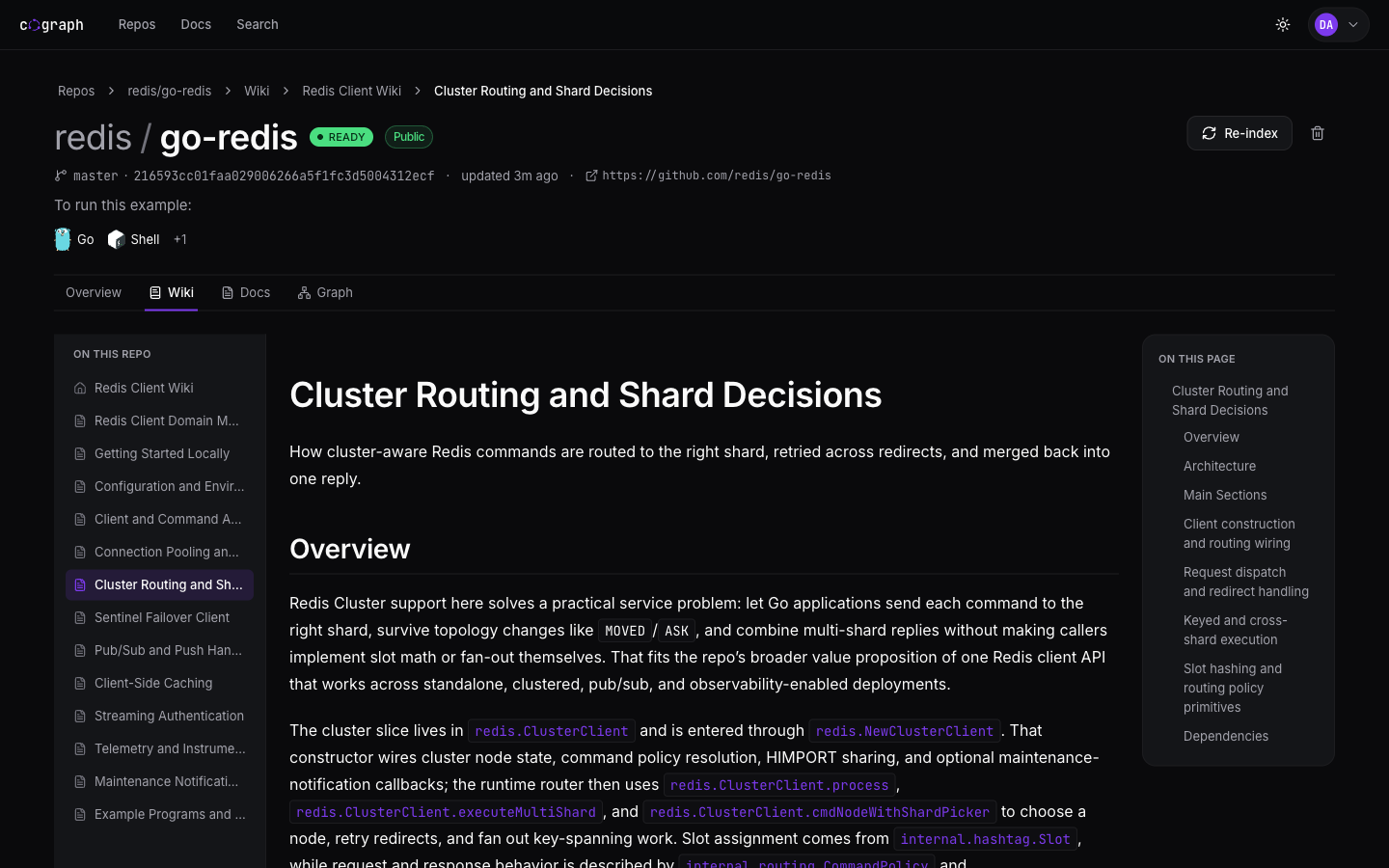
Every violet token in that prose — redis.ClusterClient, redis.NewClusterClient, internal.hashtag.Slot — is a citation, not formatting. It is a link to the graph node, and it exists because the writing agent called a tool and read that symbol. A claim the agent could not verify that way does not get a citation, and a section that cannot be cited does not ship.
Further down the same page, the diagram and the source it was derived from:
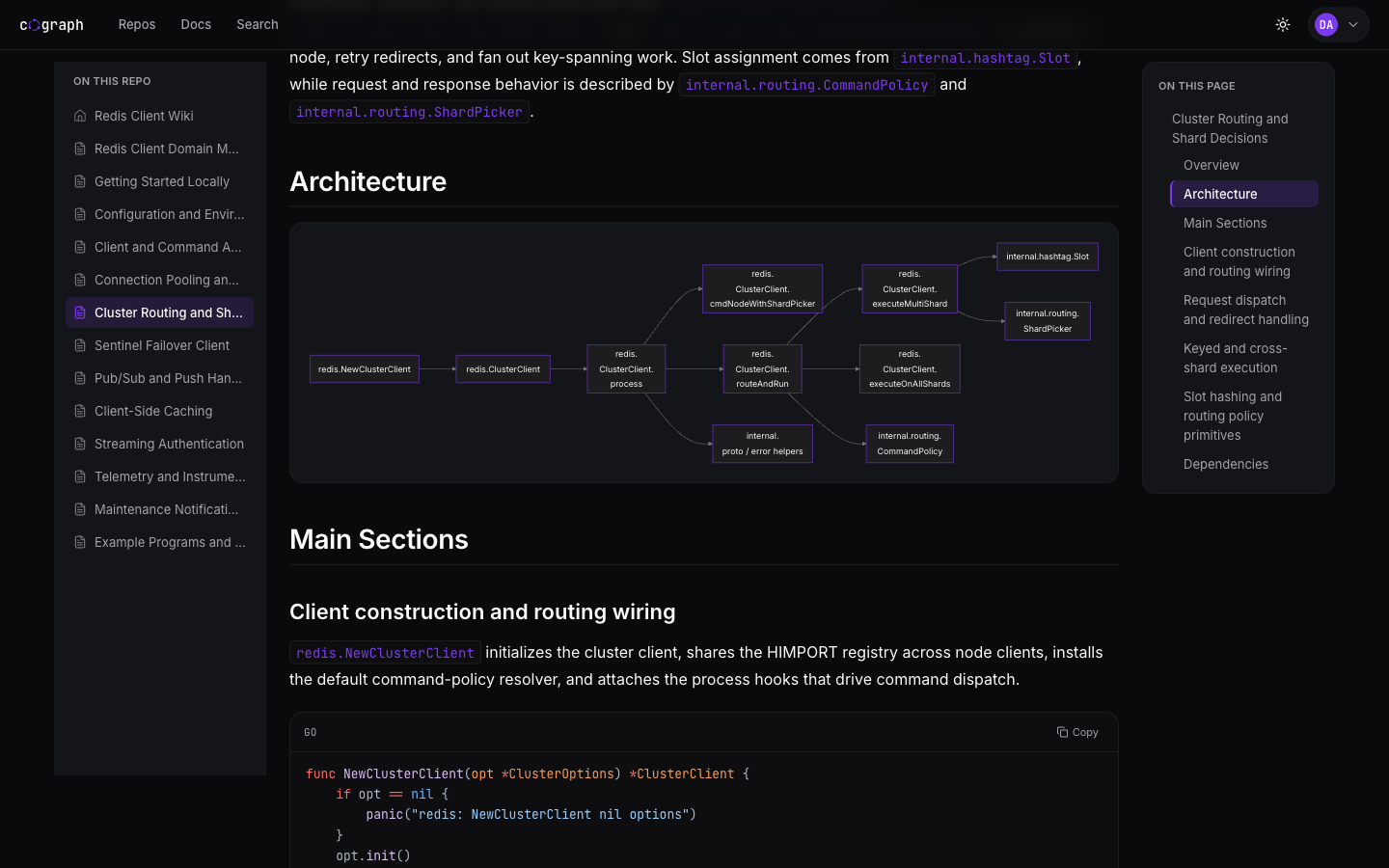
That flowchart is written by a model, but not from the model's idea of the code: the diagram pass is handed the real caller/callee edges for the nodes the page cited, and asked to draw those. So the shape follows the graph. It is still generated text — a malformed diagram is dropped and the page ships without one, but a plausible-and-wrong one would ship. The Go block under it is different: that is quoted from osscluster.go verbatim, not paraphrased.
The same page as text, so the prose is legible rather than pixels — this is one subsection of cluster-routing, copied out of the database unedited:
Slot hashing and routing policy primitives
internal.hashtag.Slotis the slot calculator used for cluster key placement. It honors Redis hash tags viaKey, then reduces the CRC16 hash into the 16,384-slot Redis Cluster range.gofunc Slot(key string) int { if key == "" { return RandomSlot() } key = Key(key) return int(crc16sum(key)) % slotNumber }Source: internal/hashtag/hashtag.go:L76-L82
internal.routing.CommandPolicydescribes how the router should treat a command: which request fan-out shape to use, which response aggregation shape to use, and whether the command should be treated as read-only for routing purposes.
In the product those two symbol links point at the graph browser rather than at GitHub; they are rewritten above so they resolve from this page. Everything else — the prose, the quoted Go, the Source: line and its line numbers — is verbatim.
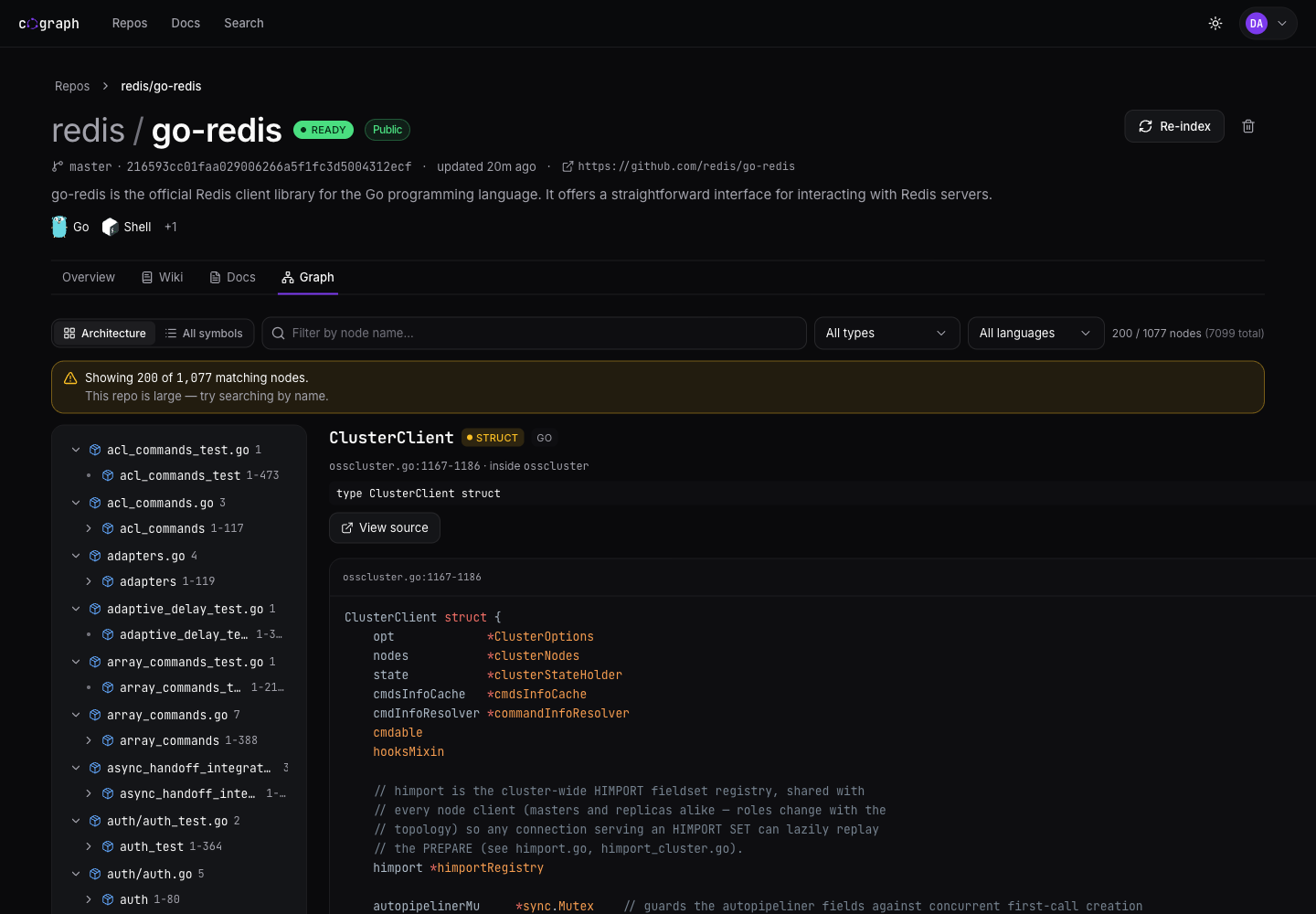
Following any citation lands on the symbol in the graph browser, at its real line range:
What it cost
The first full run, end to end:
| Step | Units | Model | Cost |
|---|---|---|---|
clone | — | — | $0 |
parse | 369 files | — | $0 |
extract_graph | 7,099 symbols | — | $0 |
embed | 7,099 nodes, 1.23M tokens | text-embedding-3-small | $0.0246 |
index_repo_docs | 110 pages | — | $0 |
embed_repo_docs | 790 chunks, 123k tokens | text-embedding-3-small | $0.0025 |
generate_summaries | 520 summaries | gpt-5.4-mini | $0.3842 |
generate_wiki | 14 pages, 8.8M in / 145k out | gpt-5.4-mini | $2.6405 |
| Total | $3.05 |

Three things in that table are worth naming, because they are the ones that surprise people:
- The wiki is 87% of the bill. Everything else together is $0.41. If wiki generation is off, indexing a 7,000-symbol repository costs cents.
- 8.8M input tokens for 14 pages is the agentic loop, not one prompt. Each page is a tool-using agent that reads code until it can cite what it wrote. 78% of that input was served from the provider's prompt cache, which is why the figure is $2.64 and not roughly four times that.
- Parsing and graph extraction are free. Structure comes from tree-sitter and SQL. The model is never asked what calls what.
These are list prices
Cograph prices usage from a table in backend/app/llm/pricing.py. If you have negotiated rates, or you are serving an OpenAI-compatible endpoint yourself, treat every figure here as an upper bound. A model that is not in the table renders — rather than $0.
What the second run cost
Then re-index with nothing changed upstream — same commit, same code:
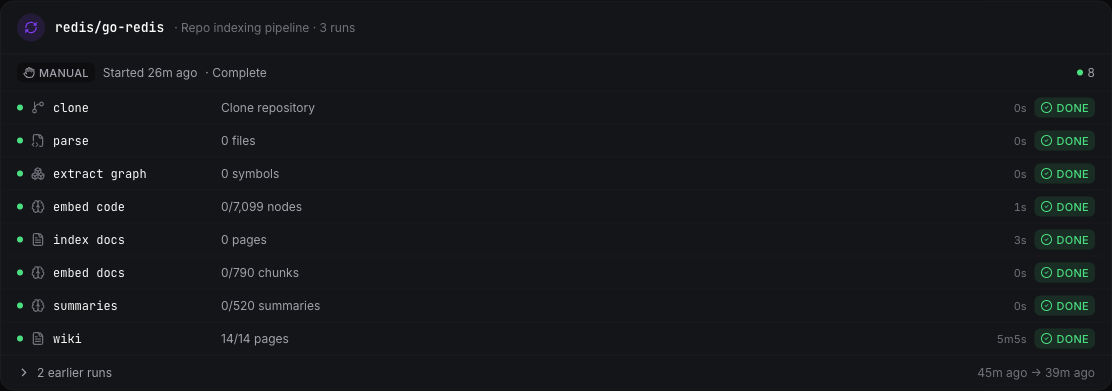
0 files, 0 symbols, 0/7,099 nodes, 0 pages, 0/790 chunks, 0/520 summaries. Every step found its work already done and did none of it. The steps still report DONE rather than skipped, because skipped means a capability was disabled — not that there was nothing to do.
The wiki shows 14/14 pages here only because the first attempt at it had been cancelled mid-run, so no page had a stamp to compare against. On a re-index of a wiki that completed, clean pages are reused the same way; see per-page reuse for what "clean" means and which edits dirty a page.
What an agent sees
The full wiki is ~48k tokens. No agent should ever be handed that, and none is. Over MCP, the default wiki surface for this repository is the compact map: every page's lead prose, its section headings, and the reader-questions it answers.
| Surface | Size |
|---|---|
| Full wiki, all 14 pages | 190,782 chars ≈ 48k tokens |
The cograph_wiki_tree resource | 15,748 chars ≈ 3.9k tokens |
| — of which the compact map | 12,426 chars |
| — of which the page tree | 3,285 chars |
That is the whole design: under 4k tokens buys an agent an accurate map of a 7,000-symbol codebase, and it pulls a full page with cograph_wiki_page only when the map is too terse for the question in front of it. Twelve times smaller, and it is the default — an agent has to ask for the expensive surface.
Reproducing this
bash
docker compose up --buildThen follow the quickstart to create the first admin and wire the embedding and completion_writer roles, add https://github.com/redis/go-redis.git as a repository, and watch /jobs.
This repository is a good test case because of the four excluded files above. Treating an unknown build tag as neutral rather than absent selects both halves of every appengine / !appengine pair — safe.go and unsafe.go then both define String, and the whole repository fails to index with GO_BUILD_VARIANT_CONFLICT. That is the defect this run was set up to find, and it found it. See build constraints.